
How does your mood and feeling affect your creativity?

A person’s creativity and mood are both tricky and complex. Yet we all wonder if our creativity is affected by our mood.
It is a common belief that how you are feeling directly affects your creativity. However, recent studies show that there is little relationship between your mood and how creative you are.
This is a summary of a study performed in partnership with SUNY Buffalo State University to find any correlation between one’s mood and creativity quotient (CQ) score. The study includes the combined results of 6,455 participants.
The research concludes that how we feel and what mood we are in, has very minimal effect on your creativity. Furthermore, it proves that, this creativity assessment is unbiased towards one’s mood and feeling.
How did we measure creativity?
We’ve developed an automated way of measuring the Creativity Quotient (CQ) through open-ended thought-provoking, outside-the-box-thinking exercises. Your CQ, which determines your ability to come up with novel ideas that are adaptive and applicable, can be assessed using four dimensions:
- Fluencyrefers to how many unique and relevant responses you can come up within a given time. Someone with high fluency would be able to conjure many different ideas, options and, therefore, more viable solutions to a given problem.
- Flexibilityis measured by the number of distinct categories your answers represent. Flexibility is about generating ideas that are different from each other. Someone with high flexibility would be able to maneuver out of a “thinking rut” by coming up with entirely new ideas.
- Originalityrefers to how infrequent your responses are compared to others’. People with high originality can come up with ideas that are statistically uncommon, but still relevant to the problem at hand and possibly break-through ideas.
- Elaborationis measured based on how detailed your ideas and solutions are. Someone with high elaboration is able to create detailed and intricate plans and embellish them with details. Note that for the purpose of this study, Elaboration was not measured. But it will be available in future studies.
How did we gather the data?
This study was conducted in partnership with SUNY Buffalo State University. As part of this study, participants completed a set of open-ended exercises such as mind-mapping, mini-saga, object-usage and improvement exercises. At the end of each set, participants were asked to fill out a set of survey questions such as how they are feeling today and other demographic information.
What do the results mean?
In general, if you are feeling good or great, you tend to have a higher overall creativity score. However, the affect is minimal and the difference between the highest and lowest scorers in each category is less than 1%.
Let’s look at each individual score independently.
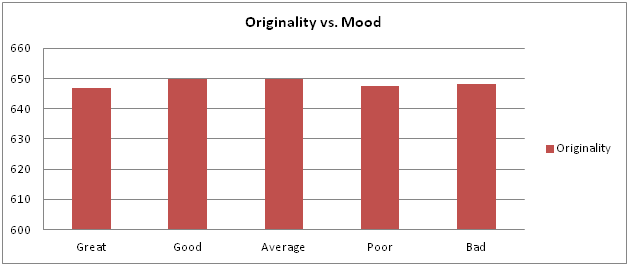
With regards to Originality, the highest scorers were individuals who were in the “good” mood with an average score of 649. The lowest scorers were in the category of feeling “poor” with an average score of 647. The difference is less than 0.5%.
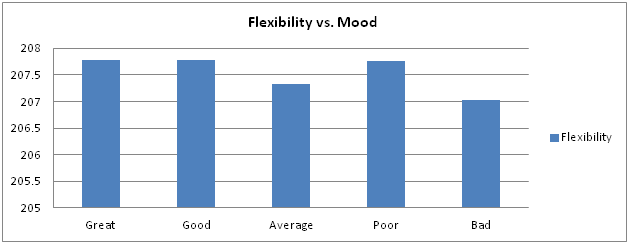
With regards to Flexibility, the highest scorers were feeling great with an average score of 207.7 and the lowest scorers were individuals who were in bad mood with an average score of 207. The difference is less than 0.5%.
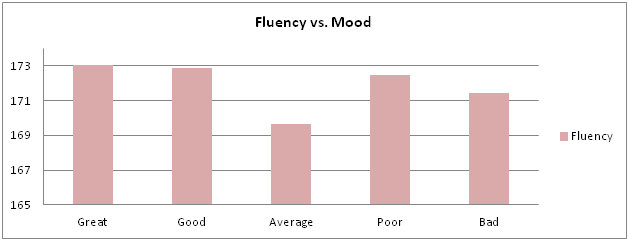
With regards to Fluency, the highest scorers were individuals who were feeling great with average score of 173 and low scorers were in “average” mood with score of 169. The difference is less than 1%.
Additional Information
For participants interested in additional information such as correlations, internal reliability, scattered plots, etc, please feel free to contact us through SparcIt’s Contact Us page.

